

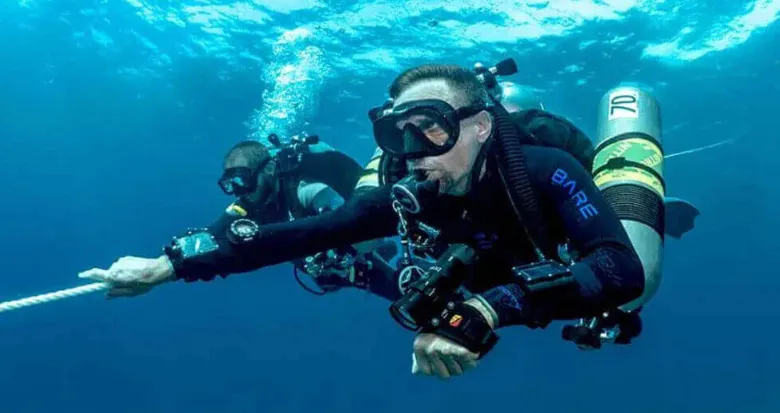
Recreational scuba diving is extraordinary — but it has limits. Standard certifications allow you to dive to depths of 30 to 40 meters on standard air, always maintaining a direct ascent to the surface.Technical diving courses are where divers choose to go beyond those limits — into deeper water, overhead environments like caves and wrecks, and complex mixed-gas diving that requires a different level of planning, equipment, and training entirely.
What Separates Technical Diving from Recreational Diving?
Technical diving (or “tec diving”) typically involves diving beyond recreational depth limits, using specialized gas mixtures like trimix or enriched air nitrox, and entering overhead environments where a direct ascent to the surface isn’t possible. Decompression stops — planned pauses during ascent to allow gases to safely leave the body — become a central part of every dive. The margin for error is significantly smaller, which is exactly why training is so rigorous.
Organizations specializing in technical diver training have been at the forefront of making these disciplines accessible since the early 1990s, and are widely credited as innovators in bringing technical diving education to a broader audience.
Starting the Tech Path: Intro to Tech Diving
The entry point for most divers into the technical world is an Intro to Tech course, specifically designed for this transition. It’s not about deep decompression diving yet — it’s about fundamentals: horizontal trim, streamlined equipment configuration, precision buoyancy, and the propulsion techniques that technical divers rely on for efficient movement in challenging environments.
These foundational skills — sometimes called “tech fundamentals” — are the bedrock everything else builds upon. Without them, progressing to more advanced courses is neither safe nor useful. Many recreational divers find that intro tech training dramatically improves their overall diving, even if they never pursue deeper technical certifications.
The Technical Divemaster
For those pursuing a professional path in technical diving, the Technical Divemaster certification is the first leadership-level credential. Unlike a recreational Divemaster who guides resort divers on reef tours, a technical diving Divemaster operates as land or boat support for technical dives, assists technical instructors, and manages the unique logistics of deep decompression or overhead environment dives.
The course requires solid technical diving credentials, a current medical exam signed by a physician, and a recreational Divemaster certification as a prerequisite. Skills must be performed to demonstration quality — the standard expected of someone guiding and supporting other technical divers.
Technical Instructor Certification
Becoming a certified technical diving instructor is among the most prestigious credentials in the diving world. Recognized technical diving agencies offer instructor courses across their full range of dive programs.
The Intro to Tech Instructor course, for example, teaches candidates how to familiarize students with technical equipment configurations, enhance foundational skills like buoyancy and situational awareness, and introduce gas planning concepts — all within a safe, structured context. The focus is on teaching methodology, not just personal diving ability.
At the highest end, leading technical diving agencies like Utila Dive Center that offer an PADI Instructor Training Workshop — typically a seven-day program that represents the pinnacle of technical diving education credentials.
Is Technical Diving for You?
Technical diving is not for everyone, and that’s okay. It demands significant time, financial investment, and a genuine commitment to training discipline. But for divers who feel the pull toward deeper wrecks, unexplored cave systems, or pushing the boundaries of what’s physiologically possible underwater, the technical path offers experiences that recreational diving simply cannot provide.
The journey from recreational diver to technical instructor is measured in years, not weeks. But for those who make it, the reward is a level of competency and access to environments that very few humans ever experience.